Tuesday, November 22, 2011

CyanogenMod 9 Ice Cream Sandwich is coming to the Galaxy Tab 10.1


One of the earliest and most important parts of Ice Cream Sandwich that Google announced was that it would integrate the code and user interface for phone and tablet versions of Android. We know that ICS tablets are due pretty soon, with Asus committing to a quick update for the upcoming Transformer Prime and Samsung already promising upgrades for its myriad tablets. Galaxy Tab 10.1 owners may not have very long at all to wait: Steve “Cyanogen” Kondik has announced that his extremely popular ROM series CyanogenMod will be coming to the Galaxy Tab when it upgrades to ICS in version 9.

The CyanogenMod team has already begun work on CyanogenMod 9 (version 7 is Gingerbread, version 8 is Honeycomb, and probably won’t be made), with stable versions expected early next year. This is the first we’ve heard of CyanogenMod supporting tablet hardware at all, with the exception of Gingerbread-based oddities for the Nook Color and the like. CM9 will be the very first version of CyanogenMod to support a tablet user interface natively, though some useful tweaks are already part of the code.
The news comes from Kondik’s personal Google+ page, and it appears that either he or someone on the CM9 team already has an extremely early version of the modification running. That’s not just good news for CyanogenMod users, it’s good for Galaxy Tab owners in general. The Cyanogen team is famously slow to release (don’t even think about asking for an ETA) but if they can manage it, earlier and less feature complete versions from other ROM makers should show up very soon indeed.

Galaxy Nexus owners reporting volume issues


Into every life a little rain must fall. For European Galaxy Nexus owners, who are currently the envy of most of the Android world, that rain is coming in the form of some frustrating volume issues. Apparently some HSPA+ phones are randomly switching between volume and sound states, much to the consternation of users. According to a quick poll, about half of users are experiencing the issue, though our own UK editor has not.
It seems that some very specific parameters must be met for the volume issue to crop up. First, you’ve got to be using the 900MHz range of spectrum for your particular carrier. Next you need to be in a relatively weak signal area, causing the Galaxy Nexus’ radio to automatically boost itself. Regions with lots of switching between 2G and 3G networks seem to be hit the hardest. Check the video below for an example:

Of course, the nice thing about owning a Nexus device is that it’s likely to be updated very soon. Google is surely taking the performance of the international model seriously, even though there’s still no official word on a timeframe for the U.S. version. Expect some official word from Google soon, with a fix in the next software update, which probably isn’t too far out.

Monday, November 21, 2011

Get Ice Cream Sandwich’s keyboard now, no root needed


Yes, we know – the wait for Ice Cream Sandwich to show up for your device and/or in your region is getting frustrating. But you can slake your hunger for Ice Cream now with a taste of its new keyboard, for any Android device. Thanks to XDA member “for.digit“. (funny how no one on XDA is ever called Bob or Sam.) He’s wrapped up the new ICS version of Android’s native keyboard in a free Market app, available to just about anyone.
It’s not quite perfect, thanks to the noticeable lack of the microphone button. And since the active voice dictation was one of the things that really put the ICS keyboard over the top, the Android Market app becomes something of a theme for the standard Gingerbread or Froyo keyboard. Given the deep integration in ICS, a significantly improved version of Voice Dictation would be almost impossible to include, though hooking into the previous versions of voice to text should be easy enough. But hey, it’s got that neat-o ice blue color scheme all the developers are going crazy for these days, right?
If you’re lucky enough to own a Nexus S, Galaxy S II or Optimus 3D, you can actually try out Ice Cream Sandwich right now. If you’re the rooted/custom ROM type, all it takes is a quick flash – just make sure to create a backup. The earliest ICS ROMs are a long way from stable. And of course, you can always pay – or wait – for the Galaxy Nexus in your home country.

Nexus S and Nexus S 4G get early Ice Cream Sandwich ROMs


Those lucky Nexus owners, they get everything sooner. In this case, it’s a relatively stable AOSP version of Ice Cream Sandwich for the previous generation of Google’s developer phone. The ROM is available for eager Android fans right now – the only thing that appears to be missing is a reliable video record function.

The work comes from XDA member “kwiboo”, and he’s been hard at work on the software for the last few days; the two separate ROMs are already on their second version. Functions are mostly complete, though the WiFi drivers need a quick patch. Since Android’s source code doesn’t include Gmail, YouTube, the Android Market and similar Google-branded apps, those packages are being directly loaded from the Galaxy Nexus.
Check out the ROM in action below:

On the example phone at least, Ice Cream Sandwich is running admirably fast. Take particular note of the ICS software buttons – or rather don’t, because they aren’t there. ICS is able to forgo its software buttons if the hardware it’s running on already has hardware-based navigation buttons. The Ice Cream Sandwich ROMs should be coming fast and furious for the next few weeks as more and more modders get a hang of the source code, and the uber-popular CyanogenMod should release its version of ICS early next year.
[via PD]

HTC Wildfire S smartphone lands at MetroPCS

Metro PCS has announced that it is now carrying the HTC Wildfire Ssmartphone. The Wildfire S is the first HTC for MetroPCS, and it features a 3.2-inch, HVGA (320 x 480 pixel) display, a 600MHz processor, and Android 2.3 Gingerbread with HTC's Sense interface. MetroPCS is selling the Wildfire S for $179.99 without a contract, and the phone can be used with Metro's $50 per month or $60 per month unlimited plans, the latter of which includes the Rhapsody Unlimited Music service. 

Adobe says Flash for ICS will be last supported OS


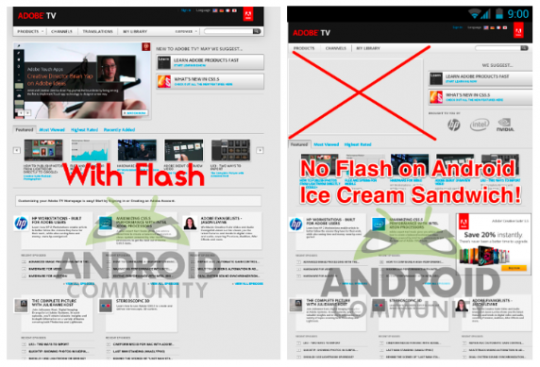
We have already talked about the fact that there was supposed to be no Flash support for Android 4.0 Ice Cream Sandwich. Adobe has now announced that it will be offering Flash for ICS after all. There is a catch though; Adobe has noted that ICS will be the last supported Android OS for Flash. That means all future version of Android will have to make it with no Flash.


Flash for Android 4.0 is expected by the end of the year. The company will continue to offer patches and security updates for existing versions of Flash after the Android 4.0 version is offered. This will get all the folks planning to get a Galaxy Nexus that lacks Flash support for content using flash.
Once those Android 5.0 handsets start to hit, Google will need to move to HTML 5 support or work something out on its own for Flash support. Android 5.0 is thought to be called Jelly Bean. That name is unconfirmed at this point.
[via Pocket-lint]

Bell to get Galaxy Nexus on December 8


In the States, we had expected to see the Galaxy Nexus before December 8 originally and then a leak from Verizon tipped the December 8 launch date. December 8 will be a shared launch date with Bell Canada too. Bell has announced that its official launch date for the Galaxy Nexus smartphone is December 8.


At this point, we are all familiar with the Galaxy Nexus. We have been playing with some review units for a while now and recently offered up benchmarks for the device. The phone turned in some strong, if not overly impressive stats in our tests. The phone is on par in many aspects with the Galaxy S II. Bell will offer the smartphone with several different contracts.
A 3-year contract will offer the phone for $159.95 in Canada. The price jumps massively if you want to shave a year off that contract to $599.95. A one-year contract is $624.95 for the smartphone and a no contract price is set at $649.95.

Snapdragon MSM8960 processor spied in benchmarks inside Asus Padfone


Someone who has an early version of the new Asus Padfone has decided to benchmark the Android device on GLBenchamrk and the results are in the database. The interesting part is that the info in the database points to a Qualcomm chip inside that hasn’t been released yet. This gives us our first idea of how well the platform will perform.


The Padfone in question appears to be running the new Qualcomm Snapdragon MSM8960 S4 processor. The MSM8960 S4 is the quad-core Snapdragon part that will combat the Tegra 3 chipset from NVIDIA. The S4 is expected to run from 1.5GHz to 2.5GHz. I’d be the 1.5GHz is what we will see in smartphone guise.
The performance for the smartphone with the S4 processor inside is very good. This Padfone should provide a nice little upgrade to the original that will be welcome when crammed inside that tablet accessory. There is no word on when the new device will launch, but it should be one of the first with the new S4 inside.
[via SlashGear]

Nook Tablet rooted for Android Market support


If you were thinking about getting the Nook Tablet, but were put off by the fact that it lacked Android Market access by default the fix is in. The Nook Tablet has been rooted to give the little 7-inch tablet unofficial access to the Android Market. Before this hack, the apps had to be sideloaded so a direct access hack to the Market is welcome.


The root is a bit more complex than some Android hacks we have seen in the past where you only need to make a click to do the deed. The hack requires that the owner of the tablet install the Android Software Developer Kit and the Java developer kit. After that is installed, the user has to enable adb on the Nook Tablet then copy and mod the Android Market app itself.
Those steps will add access to a bunch more apps to the tablet, but a few more steps offers access to even more. To get all the apps the user needs to mod the filtering system a bit to allow all compatible apps to be shown. Check out the video to see a rooted Nook Tablet in action. We went hand son with the Nook


[via SlashGear]