Saturday, December 3, 2011

Paper Zombie Lets You Cut, Shoot and Blow Up Brain Eaters – Now Available In The Market

I know we’re a little past Halloween but cuttin’ up some zombies is good anytime of the year. Paper Zombie is a new to the Android Market and boasts 300,000+ downloads on iOS. Now Android users get a chance to see what the hype is about in this cute and gruesome hack and slash. Gameplay is more or less reminiscent of something like Fruit Ninja where you swipe your screen to decapitate zombies and even have a few added weapons at your disposal like firebombs, chainsaws and shotguns.

I wouldn’t say there’s too much here in terms of depth but Paper Zombie is a great way to kill some time (and zombies) while waiting for your root canal or to keep you from dozing off in class. If you want to see the game in action a video trailer also provided for you down below. You can download Paper Zombie for free right now in the Android Market.

[Market Link]

Lookout Mobile Security Releases Carrier IQ Detector – You May Not Like What You Find


Carrier IQ. We all hate it. But not every device has it. Like the clap, sometimes you just want to know if you’re infected. Well, Lookout Mobile Security has heard your cries and has released a tool to diagnose your phone and best of all, it doesn’t require root. Simply called Carrier IQ Detector, this app will let you know if every swipe you make is being watched. Carrier IQ Detector is completely free and although it doesn’t remove Carrier IQ from your device, it can either give you peace of mind or make you even more paranoid. Let’s get some comments going to see who’s infected — you know, with Carrier IQ.
[Market Link]

US judge denies Apple injunction – Samsung sales are safe for now

It’s a good evening for Truth, Justice and the American Way, even if those on the receiving end are Korean. Reuters reports that late Friday the judge on the docket in Apple’s suit against Samsung in the United States threw out the case, stating that an injunction on Samsung’s devices would not prevent serious damage to Apple’s sales. It’s the most significant development yet in a case that’s been going on since April of this year.

In the U.S., Apple claimed that the Samsung Galaxy S, Galaxy S II and Galaxy Tab 10.1 violated its design patents, bearing a resemblance to the iPhone and iPad, respectively. In November a judge ruled that Samsung’s tablet might indeed violate the patents, but expressed doubt that such was a justification for granting a sales injunction. District Judge Lucy Koh made good on those statements today, saying, “”It is not clear that an injunction on Samsung’s accused devices would prevent Apple from being irreparably harmed.”
This isn’t the end of Apple’s litigious crusade. The Cupertino company will almost certainly appeal, though at this level of the U.S. civil court system it’s entirely possible that the appeal will be denied. Apple has a stable of patent firepower, and if this case fails completely they’re likely to fire back at Samsung with another in a few months, as they are already doing with rival Android manufacturer HTC. Apple has been particularly litigious against Samsung worldwide, particularly in Germany and Australia. Down under Apple won a preliminary injunction against the Galaxy Tab 10.1, which is scheduled to lift on December 9th, baring a successful appeal. The injunction against the same model is still in place in Germany, though Samsung has released a revised Galaxy Tab 10.1N… which Apple promplty filed a lawsuit against.

It is to be hoped that a failure in the U.S. District court system, if indeed it comes to that, will influence Apple or at least other court systems to treat the company’s frivolous and vague design patents with more skepticism. Just today Apple’s requirements for a non-violating device were made public, including “a non-rectangular shape without rounded corners” and “a thicker profile”. Though Apple’s legal crusade against Android manufacturers (and notably not against Google) is likely to continue, the decisions handed down in the U.S. and Australia indicate that judicial systems worldwide are beginning to see the company’s flawed idea of a competitive market as just that: flawed.

ASUS Transformer Prime may be at your local GameStop this weekend

Of all places, I bet you wouldn’t expect to see the highly anticipated ASUS Transformer Prime debuting in your local GameStop this weekend. However, there is a catch – it will be on display and not for sale.This will be a great time to give this tablet a test-drive to make sure it’s worth getting for either yourself or as a gift during the holiday season. We can’t imagine you’d be disappointed in the least, but it’s always best to get a personal hands-on before forking over that much money on anything.


Remember, this is the first tablet to sport NVIDIA’s Tegra 3 Quad-Core processor so try pushing it to the limit. As far as reviews go, Chris Burns wrote an excellent one of the device just today – so be sure to check it out. Just like the first ASUS Transformer, the lower dock assembly will be sold separately. Whether or not that will be included within the in-store display is unknown, but they work superbly well together so I don’t see why they wouldn’t.
The best way to find out if your GameStop will be getting any in is to call your local store directly. I’m sure they will know when/what shipments come in. I imagine more popular stores will receive them first, but since this device will exclusively be available in GameStop before other places they could be populated throughout all of them. And if you’re wondering how the Transformer Prime compares to other devices, SlashGear has conducted a great benchmark comparison.
[via Android and Me]

Sony Ericsson Nozomi pictured running Android 4.0 (Ice Cream Sandwich)

The Sony Ericsson Nozomi (LT26i) has leaked for us in a very tiny cropped picture watermarked from sebbsit168.com. It’s looking quite sleek from what we can see, but there’s really no way to tell how small or large the display actually is. My guess is it’s right at around 4″. From playing around with the Nexus S running an AOSP Android 4.0 ROM, 4″ is a great size to run ICS on.


If you zoom into the photo you’ll notice a few things; first off under the Camera heading, you can see it will take 1920×1080 video capture. Next you’ll notice it has a dual core processor and even microSD support. I’ve always been a fan of the Sony Ericsson XPERIA line, and this phone looks the best by far. Unlike the Galaxy Nexus, it seems to have three softkeys included near the chin of the device, making navigation not completely dedicated to the display.
It looks extremely thin, but then again most recent XPERIA devices (such as the Ray) were. I hope it makes it here to the states soon, because it would be a shame for the Galaxy Nexus to not have some proper competition! But chances are, our main man Chris Davies over in London will get it first – as most Sony Ericsson devices hit international waters first.
[via Phandroid]

MIUI custom ROM shows off an early Ice Cream Sandwich build

You didn’t think CyanogenMod was the only ROM starting on an Ice Cream Sandwich version, did you? The MIUI team, makers of arguably the second most popular custom ROM out there, has already begun porting their extensive set of Android customizations to run on Ice Cream Sandwich’s open source code. The developers issued a special preview on their website, with a walk-through of the updated interface.


The changes don’t look that different from the current build of MIUI, but then the aim is not to duplicate Ice Cream Sandwich‘s look. MIUI has an interface all its own, borrowing elements from Android, iOS, WebOS and the various flavors of manufacturer customizations to make something that attempts to blend the best of all available options. Just about every app, from the launcher to the music player to the phone dialer, is uniquely styled.
The developers haven’t said when they’ll release the ICS version of MIUI, but you can expect it some time in the next couple of months. Supported devices should see an immediate upgrade with updates following weekly. Like CyanogenMod, MIUI releases its source code upon publishing, so user customized versions for even more phones should begin appearing shortly after that.
MIUI has the distinction of being the only community-authored ROM that’s openly featured on a retail device, Xiaomi’s MI-One. Though the “MIUI Phone” isn’t mentioned in the latest post, it will almost certainly see a flashable update as soon as the fourth version is ready, and Chin Unicom may send an over-the-air update soon after that.
)

Samsung Nexus S Android 4.0 update rolling out to Google employees

Good news guys, it appears the process has just begun and Google is pushing the Android 4.0 Ice Cream Sandwich update to the original Samsung Nexus S. Apparently a few employees from Mountain View have received the OTA update on their very own Nexus S smartphones and it’s safe to say the “dogfooding” testing has finally started. This is a great sign and I’m sure we’ll see this available for download shortly.


The term dogfooding is Google and a few others way of saying the update is in its beta stages and is being rolled out in a controlled manor to a few devices. For now this should only be hitting those lucky few peoples phones and its being reported all over Google+. According to Android Police most of the employee tweets or posts have since been removed or deleted but don’t worry as a few readers were quick enough to snap a screenshot — and for that we thank you.

We don’t have many details at the moment other than the update is rolling out and hopefully we’ll get a leak or two shortly. If all goes well Google could be set to start the official Nexus S Android 4.0 ICS rollout in the next few weeks or around Christmas time. That would be a nice gift don’t you guys think? So much for the Galaxy Nexus being the first US device with Android 4.0 because if Google has anything to do with it they might beat Verizon to the punch, but I doubt that. Stay tuned for more details and hopefully we’ll have a download for this OTA shortly.

Motorola Xoom 2 vs Asus Eee Pad Transformer Prime


We examine Asus’ new Eee Pad Transformer Prime tablet and see how it compares to Motorola’s Xoom 2.

Form

Motorola Xoom 2 - 253.9x173.6x8.8mm, 599g

Asus Eee Pad Transformer Prime - 263x180.8x8.3mm, 586g

Motorola has embarked on a bold but cohesive new design with a number of its premium tablets and handsets including the Xoom 2, Xoom 2 Media Edition and Razr smartphone.

They all feature a rather dynamic looking aesthetic with tapered edges and extremely thin profiles. It’s a look we approve of as not only is it interesting to behold but also makes the brand highly distinctive and easily recognised.

According to Motorola’s official blurb the Xoom 2 sports an aluminium ‘housing’ which makes it 10 per cent lighter than its predecessor, it’s also apparently 33 per cent thinner.

In real terms it’s 8.8mm thick – which is better than many current phones, and weighs 599g, which for a 10-inch tablet is very light indeed.

We also like the spacing of the bezel around the screen which is quite flattering for the tablet as a whole. Generally we think the Xoom 2 is one seriously stylish device.

Asus’ Transformer Prime has also been on a strict diet and is again competing with contemporary smartphones with its svelte 8.3mm thick bodywork.

Likewise it also uses aluminium in its construction, though perhaps more extensively than its rival as the whole thing has been crafted from ‘spun’ anodised aluminium for an interesting textured look.

We should also mention the accompanying keyboard docking station (which can be bought separately) which is supposed to be as thin and light as the rest of the device.

Of course, being a tablet but also a laptop much of the Transformer Prime’s shape and design has been dictated by this dual role.

It’s not as distinctive as the Xoom 2 but it’s still a gracefully designed piece of kit which will wow you with its looks.

Ultimately though, the Xoom 2 has the edge when it comes to visual flair and we have to vote for Motorola’s offering this round.

Winner – Motorola Xoom 2

Display
Both devices have equally large 10.1-inch capacitive touchscreens, they’re both made from tough Gorilla Glass and sport a 1280x800 pixel resolution and a pixel density of 149 pixels-per-inch (ppi).

Each has built-in accelerometer and gyro sensors.

The Xoom 2 has multi-touch, as does the Transformer Prime but Asus' device can boast ‘ten finger’ multi-touch capability for even more versatility.

Motorola’s device has a standard TFT screen while the Asus is fitted with an LED backlit 'IPS +' display.

The Asus Transformer Prime is offering a little more overall here but generally speaking these are both excellent displays and we doubt many people would be disappointed with either.

Winner – Draw

Storage

On storage, the Xoom 2 is part of a new wave of devices which rely more on cloud storage services than internal capacity – a policy which may or may not be successful and only time will tell.

As a result it packs 16GB of onboard space alongside 1GB of RAM but no microSD capability.

Instead, the tablet can connect to Motorola’s own MOTOCAST service for streaming music and video content direct from a home PC across a considerable distance, meaning you can be in a totally different part of the country and it’ll still work.

The Asus Transformer Prime takes a more conventional approach with options for either 32GB or 64GB of in-built storage and 1GB of RAM in either case, it also has microSD capability up to a further 32GB.

We don’t object to cloud-based solutions but aren’t especially fond of the mutually exclusive approach, we’d rather have both onboard and cloud rather than a predominantly cloud bias of the Xoom 2 which could potentially become a handicap in certain situations.

What’s more, cloud or no cloud we still see microSD as a useful bonus and miss its absence when it’s not there. We think the Transformer Prime has the advantage here.

Winner – Asus Eee Pad Transformer Prime


Processor
Both tablets are powered by ARM Cortex-A9 processors running NVidia chipsets but they’re quite different configurations.

The Xoom 2 is dual core on the Nvidia Tegra 2 T20 chipset and clocked at 1.2GHz, it also uses an Nvidia ULP Geforce graphics processing unit (GPU).

The Transformer Prime uses the same GPU but is a quad core setup on the NVidia Tegra 3 chipset and clocked at 1.3GHz.

The thing is, both these devices are powerful enough to effortlessly deal with anything you can throw at them, there isn’t any app or game on the market currently which will cause either to break a sweat.

Because they’ll both perform so well you probably wouldn’t notice much of a difference between the two if you ran them alongside each other.

So, in the end it becomes about future-proofing, both are very well future-proofed and will continue to perform well for some time to come, but the quad core Asus will probably outlast the dual core Motorola when the rest of the industry follows down the quad core path and more demanding content emerges.

Winner – Asus Eee Pad Transformer Prime

Operating System
These are both running the latest tablet-specific Android build, 3.2 Honeycomb.

Asus has confirmed the Transformer Prime will be updated to Ice Cream Sandwich (ICS) 4.0, the new cross-platform build for both phones and tablets, though whether this will happen before 2012 or a short way into it isn’t clear right now.

Motorola must surely be thinking about a similar strategy having released a new Android tablet so close to ICS’s launch but there’s no definite word from the company yet.

We’re expecting it to follow suit sooner or later.

For now though, they’re both on Honeycomb, which is a pretty good system.

It's certainly an improvement on the previous 2.3 Gingerbread smartphone build with much more intuitive control of multi-tasking and customisation and a considerably enhanced web browsing experience.

You’ve also got a huge choice of apps and games on this platform.

It’s not perfect but we find ourselves scraping the barrel for what are comparatively minor gripes.

One which actually does bug us is the touch keyboard because the close keyboard key is right next to the letters/numbers toggle, meaning you’ll continuously be closing the keyboard by accident.

At any rate, they’re both on the same platform so on a pretty even footing.

That will change with time as the Asus gets ICS but it could also change back to an equal level again if the Xoom 2 does too.

Winner - Draw

Camera
For a while now cameras have been an apparent secondary concern for tablet manufacturers, which to some extent is understandable.

However, so too is the notion of ‘having your cake and eating it too’, when it comes to consumer tech anyway.

With these two devices the cameras have received a bit more attention than many of their contemporaries.

The Xoom 2 has a 5-megapixel primary shooter at a resolution of 2592х1944 pixels and capable of 720p video capture. Features include LED flash, autofocus and geo-tagging, plus a 1.3-metapixel secondary camera.

Asus has really raised the bar with an 8-megapixel primary at 3264x2448 pixels. Video quality is 1080p and it features LED flash, touch focus, autofocus, geo-tagging and a 1.2-megapixel secondary camera.

Both are quite light on the features but decent offerings nonetheless. We think the Asus takes the lead, however.

Winner – Asus Eee Pad Transformer Prime

Final Thoughts
The Asus Transformer Prime won in more rounds but ultimately we wouldn’t say it’s a ‘better’ tablet than the Xoom 2.

We think these are both fantastic Android tablets with a lot of potential to last for a good while.

For a distinction between the two we’d say that the Asus will be a more viable choice further into the future but that doesn’t mean the Xoom 2 isn’t a great c

hoice right now.

Android gains ground from BlackBerry in latest US mobile comScore figures

The outlook has been grim for RIM’s BlackBerry platform for some time, and new figures out today from comScore add to the gloom.
The data company’s report, looking at mobile market share in the US in October 2011, shows BlackBerry dropping 4.5 percentage points in terms of share of smartphone subscribers since July, dropping to 17.2% of the market. Meanwhile, Google’s Android has gained 4.4 percentage points, extending its lead with 46.3%. Apple saw a modest gain rising 1 percentage point to 28.1%.
Meanwhile, Microsoft and Symbian’s market shares by platform both saw modest 0.3 percentage point declines in the three months up to October.

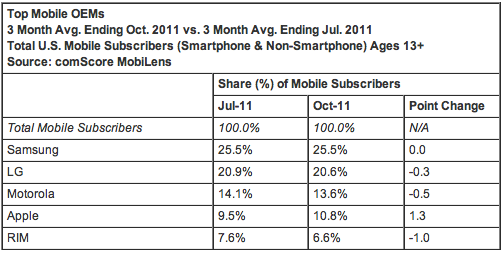
There was little change in terms of manufacturer market share though. Samsung held steady at the top, with 25.5% of the market. LG, Motorola saw modest declines of less than 1%. RIM was down 1% and Apple saw a 1% gain, perhaps helped by interest in the iPhone 4S, released in mid-October.
Screen Shot 2011 12 02 at 17.44.28 Android gains ground from BlackBerry in latest US mobile comScore figures